How deals work
How a discount percentage is calculated, and what it is calculated from
The same $30 off reads as 25% or 67% depending only on the reference price. How the badge arithmetic works and what the FTC pricing guides require of it.
Every percentage has two numbers in it and the advertisement usually shows one. The saving is visible; the price it is divided by is the claim. Change the divisor and the same dollar saving can be badged as a quarter off or as two thirds off without a single cent moving.
This guide works through the arithmetic, then through what the Federal Trade Commission's Guides Against Deceptive Pricing actually require a reference price to be. It cites the published rules rather than describing any retailer's behaviour, because this site runs no price tracker and has observed no seller's pricing over time.
Every percentage has a denominator
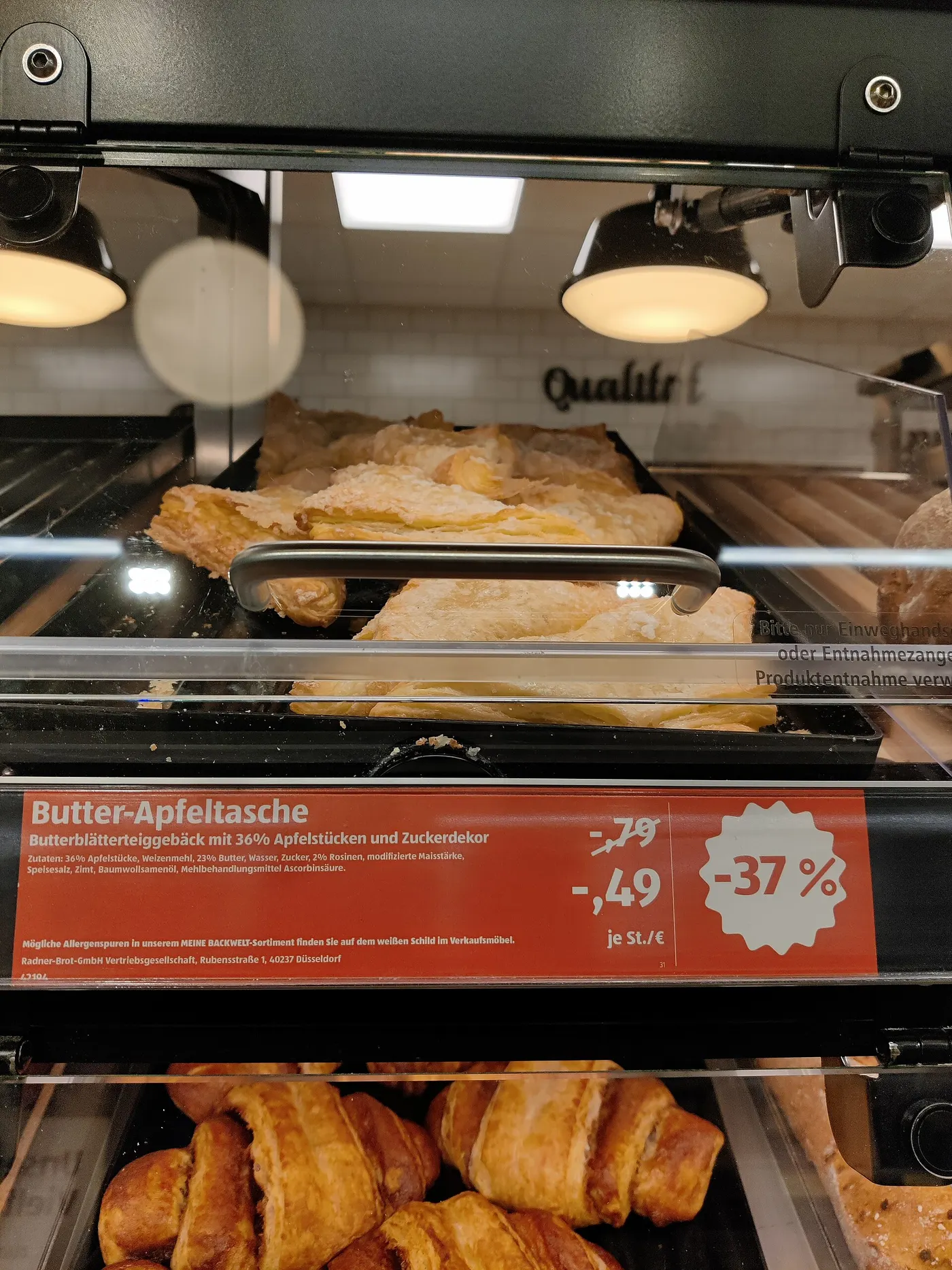
The badge is one division: the saving divided by the reference price. A label photographed in a bakery shows a struck-through price of 0.79 and a new price of 0.49, with a badge reading minus 37 per cent. The saving is 0.30 and 0.30 divided by 0.79 is 0.3797, which the badge has rounded down to a whole number. Nothing is hidden there — but notice that the only figure doing work is the 0.79.
Hold the saving still and move the reference price and you can see the whole mechanism. Thirty dollars off a $120 reference is a 25% badge. The same $30 off a $60 reference is a 50% badge. The same $30 off a $45 reference is 67%. The shopper's bank balance changes by exactly $30 in all three cases.
This is why 'up to 50% off' across a whole page is the weakest form of the claim. It says that at least one item in the set reaches that figure against its own reference, and says nothing at all about the item you are looking at. Working out the badge for the single item in front of you takes one division and is the only version of the number that applies to your order.
| Reference price shown | Price you pay | Dollars saved | Percentage the badge can claim |
|---|---|---|---|
| $120 | $90 | $30 | 25% |
| $90 | $60 | $30 | 33% |
| $60 | $30 | $30 | 50% |
| $45 | $15 | $30 | 67% |
Each percentage is 30 divided by the reference price: 30/120 = 0.25, 30/90 = 0.333, 30/60 = 0.50 and 30/45 = 0.667. The dollars saved are identical in every row.
What a former price is required to be
The Guides Against Deceptive Pricing at 16 CFR Part 233 deal with exactly this. On former price comparisons, they state that if the former price is the actual, bona fide price at which the article was offered to the public on a regular basis for a reasonably substantial period of time, it provides a legitimate basis for advertising a price comparison. The three load-bearing words there are actual, regular and substantial.
The Guides are equally direct about the failure case. Where an artificial, inflated price was established for the purpose of enabling a subsequent offer of a large reduction, the bargain being advertised is a false one and the purchaser is not receiving the unusual value expected. They also warn advertisers away from wording such as 'formerly sold at' unless substantial sales were actually made at that price — asking price and selling price are different claims.
Two neighbouring sections cover the other two shapes of reference price. On retail price comparisons, the advertiser should be reasonably certain that the higher price advertised does not appreciably exceed the price at which substantial sales are being made in the area. On manufacturers' list prices, a list price is not deemed fictitious if it is the price at which substantial sales are made in the advertiser's trade area, and where the list price significantly exceeds the highest price at which substantial sales occur there is a clear danger of consumer deception.
| Type of comparison | Section | The test the Guides state |
|---|---|---|
| The seller's own former price | 233.1 | An actual, bona fide price offered to the public on a regular basis for a reasonably substantial period of time |
| Comparable value or retail price in the area | 233.2 | The higher price should not appreciably exceed the price at which substantial sales are being made in the area |
| Manufacturer's list or suggested price | 233.3 | Not fictitious if it is a price at which substantial sales are made in the advertiser's trade area |
| Bargain conditional on buying something else | 233.4 | The seller must not raise the price, cut the quantity or quality, or attach other strings to the required article |
The Guides express the Commission's view of what is unfair or deceptive under the FTC Act. They are the yardstick a claim is read against, not a certification scheme, and they describe no particular seller.
The percentage is never calculated on what you actually pay
A badge applies to the merchandise line and nothing else. Take a $100 item at 20% off with a $10 code applied afterwards: the merchandise falls to $70. Add $7 of shipping and assume sales tax of 8% charged on the $70 of merchandise, which is $5.60, and the card is charged $82.60. The badge said 20% off; the amount charged is 17.4% below the $100 you started from, because shipping and tax were never inside the percentage.
The order of operations matters as well, and it is set by the seller rather than by you. Taking the percentage first and the code second gives $100 minus 20% equals $80, minus $10 equals $70. Taking the code first gives $100 minus $10 equals $90, minus 20% equals $72. That is $2 of merchandise and, with tax at 8%, $2.16 of total difference on an identical pair of offers.
Sales tax in the United States is set by state and locality rather than nationally, so the 8% used above is an assumption written here to show the shape of the calculation rather than a rate that applies anywhere in particular. Put your own rate, your own shipping and the two discounts into the discount-truth and landed-cost calculators on this site and the comparison becomes a single figure.
| Step | Percentage applied first | Code applied first |
|---|---|---|
| Starting price | $100.00 | $100.00 |
| After the first reduction | $80.00 | $90.00 |
| After the second reduction | $70.00 | $72.00 |
| Shipping added | $77.00 | $79.00 |
| Sales tax at 8% on merchandise | $5.60 | $5.76 |
| Total charged | $82.60 | $84.76 |
The 8% rate is an assumption used to show the arithmetic; sales tax is set by state and locality. The $2.16 gap between the two totals comes entirely from the order in which the seller applies its own two reductions.

Where a total price is actually required up front
There is one federal rule that requires an up-front total rather than a headline, and its scope is narrow. The Rule on Unfair or Deceptive Fees, at 16 CFR Part 464, became effective on May 12, 2025 and applies to businesses that offer, display or advertise live-event tickets and short-term lodging. A covered business must tell people up front the total price they will pay and must display that total more prominently than other pricing information.
Even inside that scope, three things may sit outside the total: taxes and other government charges, shipping charges, and charges for optional goods or services the buyer chooses to add. Those excluded charges still have to be disclosed before the business asks for payment, and the final amount of payment must be shown at least as prominently as the total price.
For ordinary retail the rule does not apply, and the general standard is the one in the FTC's small-business advertising guidance: disclose the most important information, such as the terms affecting the cost of the offer, near the advertised price. In practice that means the shipping threshold and the return terms belong next to the badge, and a page that puts them three clicks away has left the reader to do the arithmetic blind.
- 16 CFR Part 464 took effect on May 12, 2025 and covers live-event tickets and short-term lodging
- Covered businesses must show the total price up front and more prominently than other pricing information
- Taxes and government charges, shipping, and optional add-ons may sit outside that total but must be disclosed before payment is requested
- Outside that scope, the general requirement is that terms affecting the cost of the offer are disclosed near the advertised price
Checking a badge in under a minute
The routine is short. Write down the reference price the badge is using, then ask whether the page tells you what that price is — the seller's own earlier price, a manufacturer's list price, or an unexplained 'value'. An unexplained reference is not evidence of anything, and it is the case the Guides are written about.
Then recompute. Divide the saving by the reference price yourself rather than trusting the badge, because rounding, bundled items and per-unit pricing all shift the figure. Finally, add shipping and your own tax rate to get the number that actually leaves your account, which is the only one that can be compared against another seller's number.
- Write down the reference price the badge is dividing by, and note whether the page says what kind of price it is
- Divide the dollar saving by that reference price yourself and compare with the badge
- Check whether the badge belongs to the specific item or to an 'up to' claim across a page
- Add shipping and your own sales tax rate to reach the amount actually charged
- Compare that amount against another seller's equivalent total, not against another badge

Before you buy
- Identify the reference price the badge is dividing by before looking at the percentage
- Check whether the page says what kind of reference price it is: former, list or comparable value
- Recompute the percentage yourself from the dollar saving
- Treat an 'up to' claim as applying to the set, not to your item
- Add shipping and your own sales tax rate to reach the amount actually charged
- Compare that total against another seller's total rather than against another badge
- For tickets and lodging, look for the up-front total price the rule requires
Questions readers ask
- Does 'up to 50% off' mean anything?
- Only that at least one item in the set reaches that figure against its own reference price. It says nothing about the item you are looking at, which may be reduced by 5% or not at all. The useful number is the single division for your item: its dollar saving divided by its own reference price, which takes about 10 seconds.
- Is a manufacturer's list price a fair comparison?
- The Guides treat a list price as not fictitious if it is a price at which substantial sales are made in the advertiser's trade area. Where it significantly exceeds the highest price at which substantial sales occur, the Guides say there is a clear danger of consumer deception. A list price nobody has paid in years is the case the section is written about.
- Why does a discount code sometimes save less than expected?
- Because the order in which the seller applies its reductions is set by the seller. On the $100 example here, applying 20% first and a $10 code second leaves $70 of merchandise; applying the code first leaves $72. With $7 shipping and an assumed 8% sales tax that is a $2.16 difference on identical-looking offers.
- Do advertised prices have to include tax and shipping?
- Generally no. The Rule on Unfair or Deceptive Fees requires an up-front total only for live-event tickets and short-term lodging, and even there it permits taxes, government charges, shipping and optional add-ons to sit outside the total as long as they are disclosed before payment is requested.
- How do I compare two sellers properly?
- Compare totals rather than badges. Take each seller's merchandise price after all reductions, add its shipping charge and your own sales tax rate, and compare the two amounts that would leave your account. The landed-cost calculator on this site takes those inputs so the comparison is one subtraction rather than four.
Sources
- 16 CFR Part 233 — Guides Against Deceptive Pricing, sections 233.1 to 233.5 (U.S. Government Publishing Office) — checked 2026-11-03
- Federal Trade Commission — The Rule on Unfair or Deceptive Fees: Frequently Asked Questions (16 CFR Part 464, effective May 12, 2025; scope and permitted exclusions) — checked 2026-11-03
- Federal Trade Commission — Advertising FAQ's: A Guide for Small Business (price comparison and 'sale' price claims; disclose terms affecting cost near the advertised price) — checked 2026-11-03
Some links on this site can earn us a commission. That does not change which product a guide recommends, and it adds nothing to your price. Advertising is not enabled on this site yet. When it is, ads will be labelled and kept visually separate from the guides.